What the benchmark tests
Retrieval from long labels, exact warning and dosage extraction, multi-section synthesis, cross-label comparison, mixed batches, and calibrated refusal for near-miss questions.
LLM evaluation and grounded clinical QA
A reproducible benchmark for testing whether LLM agents can reason over FDA drug labels while preserving evidence, clinically important qualifiers, and refusal discipline.
The project moves beyond answer similarity with isolated Harbor tasks, hidden deterministic verifiers, fractional rewards, and trajectory-level failure analysis.
Independent research benchmark. The 0.700 aggregate covers 23 recorded scored hard-set trials; the plots below compare a narrower three-run Gemini subset. Benchmark outputs are not medical advice.
01 / Problem
In label-grounded QA, an answer can sound plausible while citing the wrong product, dropping a population restriction, changing a dose, or answering a claim the source never supports.
Retrieval from long labels, exact warning and dosage extraction, multi-section synthesis, cross-label comparison, mixed batches, and calibrated refusal for near-miss questions.
Every expected question ID must be present in valid JSON, cited passages must belong to the correct label, quotes must occur in those passages, and clinical claims must retain their qualifiers.
02 / Pipeline
The workflow keeps data profiling, task construction, execution, scoring, and error analysis reproducible as separate stages.
01
Inspect 704 FDA labels and 17,207 QA rows to map label length, task type, citations, and refusal coverage.
02
Generate seven challenge families spanning long retrieval, warnings, dosage, refusal, synthesis, comparison, and mixed batches.
03
Expose questions and label passages while keeping expected facts, qualifiers, and citation checks inside hidden verifiers.
04
Package each suite as an isolated Harbor environment and preserve job configuration, trajectories, timing, cost, and rewards.
05
Combine strict pass/fail with a deterministic fractional rubric for structure, content, qualifiers, citations, and refusals.
06
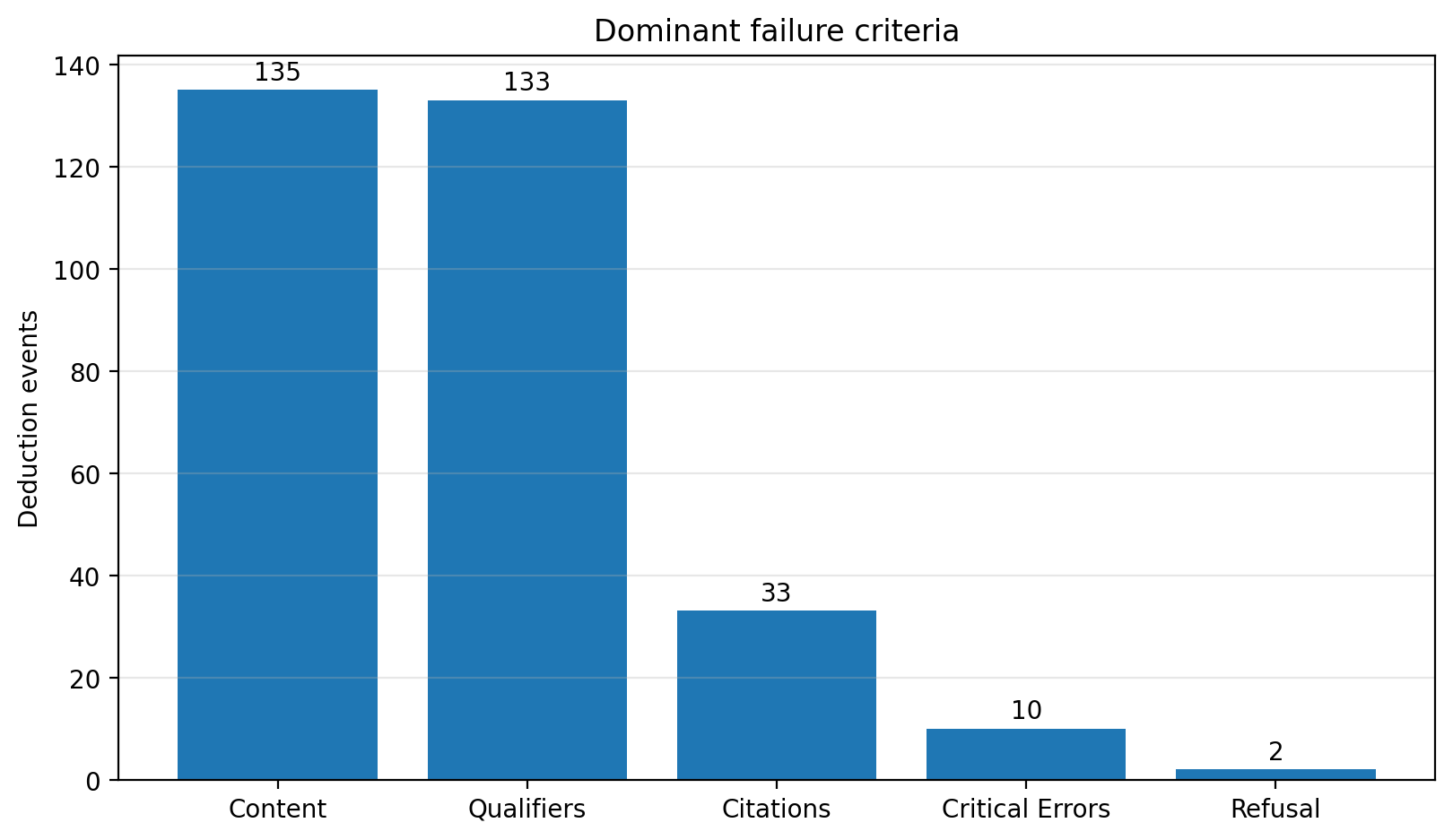
Trace deductions back to answer content, clinical qualifiers, citation support, critical errors, and refusal decisions.
03 / Verifier
Binary pass/fail protects the safety-critical threshold, while fractional reward reveals whether a failure came from structure, content, qualifiers, citations, or refusal behavior.
Answer content
35%Clinical qualifiers
20%Citation support
25%Refusal correctness
10%Schema and coverage
10%A run passes only at an aggregate score of at least 0.85 with no critical errors. Wrong dose, unit, route, population, cross-label citation, unsupported answer, invalid JSON, or question-ID mismatch can force a failure even when partial reward remains high.
04 / Results
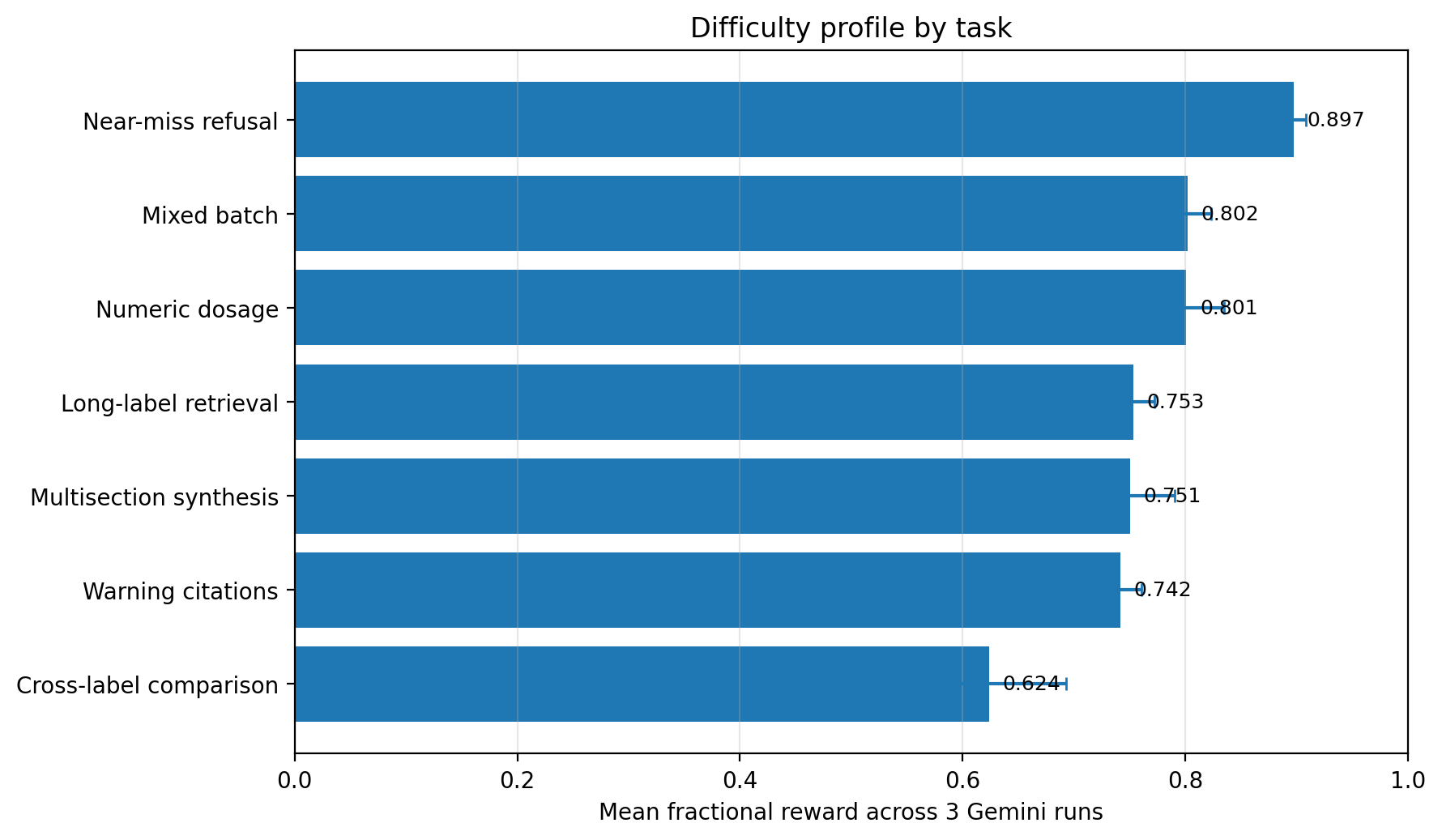
Refusal behavior was strongest. Warning retrieval and long-label retrieval were hardest, while dosage and mixed-batch outputs often looked close but missed strict qualifiers or structured fields.
| Task family | Trials | Mean reward | Pass@1 |
|---|---|---|---|
| Warning citations | 4 | 0.556 | 0.0% |
| Long-label retrieval | 4 | 0.565 | 0.0% |
| Cross-label comparison | 3 | 0.624 | 0.0% |
| Multisection synthesis | 3 | 0.751 | 0.0% |
| Numeric dosage | 3 | 0.801 | 0.0% |
| Mixed batch | 3 | 0.802 | 0.0% |
| Near-miss refusal | 3 | 0.897 | 100% |
05 / Evidence
Fractional scoring exposed a gap that strict pass rates alone hide: outputs were frequently structurally valid and broadly relevant but still lost credit for content precision and clinically meaningful qualifiers.
06 / Judgment
The benchmark is designed as an auditable research scaffold. Its claims stay bounded to the recorded corpus, verifier, and runs.
07 / Repository
The repository includes the Harbor task environments, builders, hidden-verifier logic, tests, job artifacts, aggregate tables, and trajectory failure reports used for this case study.